Homeowners' pick for appliance repair across Alabama
Dryer Vent Cleaning & Repair — Book a Visit Today
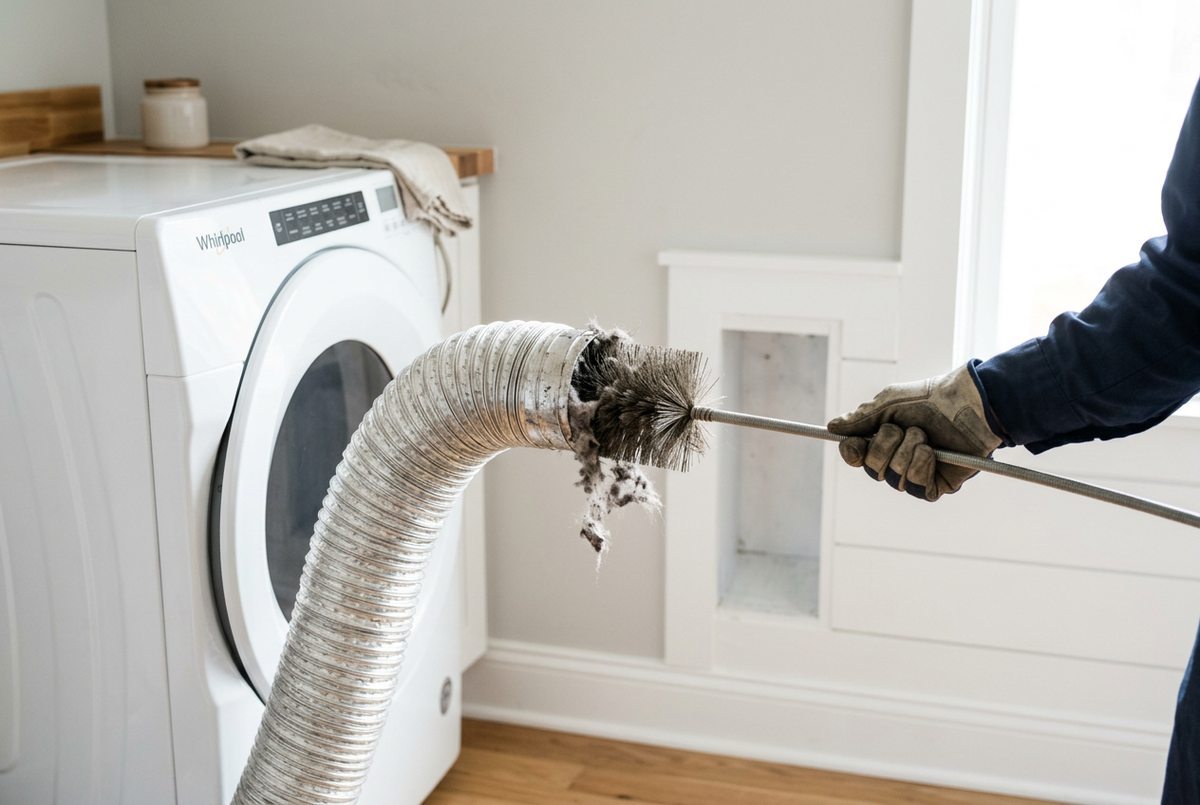
We diagnose and clean dryer vents in Alabama homes, and the visit starts with an airflow reading instead of a vacuum hose. A vent is a simple duct with a hard job. Lint packs the walls, crushed foil pipe behind the machine chokes airflow, and roof or wall flaps stick shut. Long runs with too many elbows hold moisture. The dryer then runs hot, runs long, and wears out parts early. We measure airflow, open the duct where it counts, check the termination cap outside, and look at how the duct is routed and joined. Then we clean, reroute, or replace the damaged section and re-test. Crushed transitions get swapped for smooth metal. If clothes come out damp and the room smells warm, call us and tell us what you see.
Call (800) 712-6387- Real people on the phone
- 7 days a week
- Quote in writing before any work
Taking calls until 5:00 PM CT
The dryer vent cleaning & symptoms we hear most
- "Clothes are still damp after two cycles" Restricted exhaust, usually lint buildup or a collapsed transition hose
- "The laundry room gets hot and humid" A leaking or disconnected duct joint is venting indoors
- "Outside flap never opens anymore" Blocked termination cap: lint mat or a bird nest at the exit
- "Dryer shuts off partway through" Thermal limit tripping on trapped heat and low airflow
- "Burnt smell when the dryer runs" Lint scorching against hot surfaces. Stop using it and have it inspected
Safe things to check first
Worth a look before you call — sometimes it saves you the visit.
- 1Peek behind the dryer and see whether the flexible hose is kinked, crushed, or pulled loose.
- 2Step outside while the dryer runs and feel whether warm air is really pushing out.
- 3Pull the lint screen and hold it up to a light; film from dryer sheets blocks flow.
- 4Look for lint dust piling on the floor near the duct. That points to a leaking joint.
What homeowners get from an independent shop
| G Appliances MD | Big-box repair chains | Handyman listings | |
|---|---|---|---|
| Written quote before any work | ✓ | ✕ | ✕ |
| Live answer seven days a week | ✓ | ✕ | ✓ |
| Every major brand, gas or electric | ✓ | ✓ | ✕ |
| No manufacturer targets to hit | ✓ | ✕ | ✓ |
| Crews familiar with homes like yours | ✓ | ✕ | ✓ |
Homeowners on how the visit went
“Fridge died the week groceries were stocked for a birthday. They squeezed us in same day.”
Cliff T.Luverne, AL“Zero pressure at any point. The quote sat in my inbox for two days while I decided, no chasing calls.”
Rita M.Eutaw, AL“He leveled the machine, replaced the pump, and ran a full cycle before leaving. Thorough.”
Dean S.Hartford, ALDryer Vent Cleaning & Repair — quick answers
How often should a dryer vent be cleaned?
Once a year suits most homes. Long duct runs, big families, or pet bedding loads may need it sooner. If drying time creeps up between cleanings, that's the real signal. We'd rather check airflow than guess by the calendar.
Can I just use a shop vac myself?
A shop vac clears the first foot or two. Packed lint usually sits farther in, at elbows and near the exit cap, and rotary brush tools reach that. We also inspect the joints and the termination, which a vacuum tells you nothing about.
Is flexible foil duct a problem?
Ridged foil and plastic duct catch lint and crush easily behind the machine. Rigid or semi-rigid metal keeps the path smooth and holds its shape. When we find flattened duct, we recommend replacing that section rather than only cleaning it.
Why does my dryer take so long even after cleaning?
Airflow may still be limited by a long route, too many elbows, or a stuck exterior flap. It can also be the machine: a weak blower wheel, or a failing heat element. We test both sides before we say which.
Do you handle roof-terminated vents?
Yes. Roof runs are common and they collect lint fast because of the vertical climb. We clean from the accessible ends and check the cap for screen mesh, which traps lint and should not be there.
What if my duct is behind a finished wall?
Most concealed runs can be cleaned end to end without opening drywall. If a section is disconnected inside the wall or cavity, we'll show you what we found and talk through rerouting options. Call us and describe your layout.
How it works
- Step 1
Describe the symptom
Tell us what you hear, smell, or see. Is it grinding, is there a puddle on the floor, is a code blinking at you? Small details narrow the list of likely causes before we ever pull the machine away from the wall.
- Step 2
We examine the machine
A technician works a checklist: power, controls, sensors, motors, seals, drainage. We test instead of guessing. Then we walk you through the actual fault and what your repair options are.
- Step 3
You choose the treatment
Some faults are worth fixing the same day. Others mean the appliance is near the end of its life. We tell you which one you're looking at, and we finish the repair once you say go.
- A real person answers
- Open 7 days
- Written quote before work starts
Why homeowners call us
- We think like diagnosticiansSwapping parts until something works costs you time. We trace the symptom back to its cause and confirm it with a test, then repair the thing that actually failed rather than the thing that merely looked suspicious.
- Second opinions are fine by usSomeone already told you the compressor is done, or that the control board is fried? Bring us in to check. We'll run our own examination and tell you honestly whether that diagnosis holds up.
- Brand-independent serviceWe're an independent repair company, and we work on refrigerators, washers, dryers, dishwashers, ovens, ranges, and freezers from all major brands. No brand steers our recommendation toward replacement over repair.
- Straight talk on repair or replaceNot every appliance deserves a rescue. If the numbers and the condition point toward a new unit, we say so. What you get is facts about your machine, not pressure to book work.
- All major brands, gas & electricEvery major appliance brand, gas and electric, handled by an independent shop.
- Straight answersWhen a repair doesn't make sense, we tell you, sometimes before we even roll a truck.
Dryer Vent Cleaning & Repair
Small faults become big ones on a schedule of their own
Describe the symptoms and we'll book the visit — takes about a minute.
- A real person answers
- Open 7 days
- Written quotes
- All major brands
- Gas & electric
Rather not call? Get a free quote →