Homeowners' pick for appliance repair across Alabama
Oven Repair — Book a Visit Today
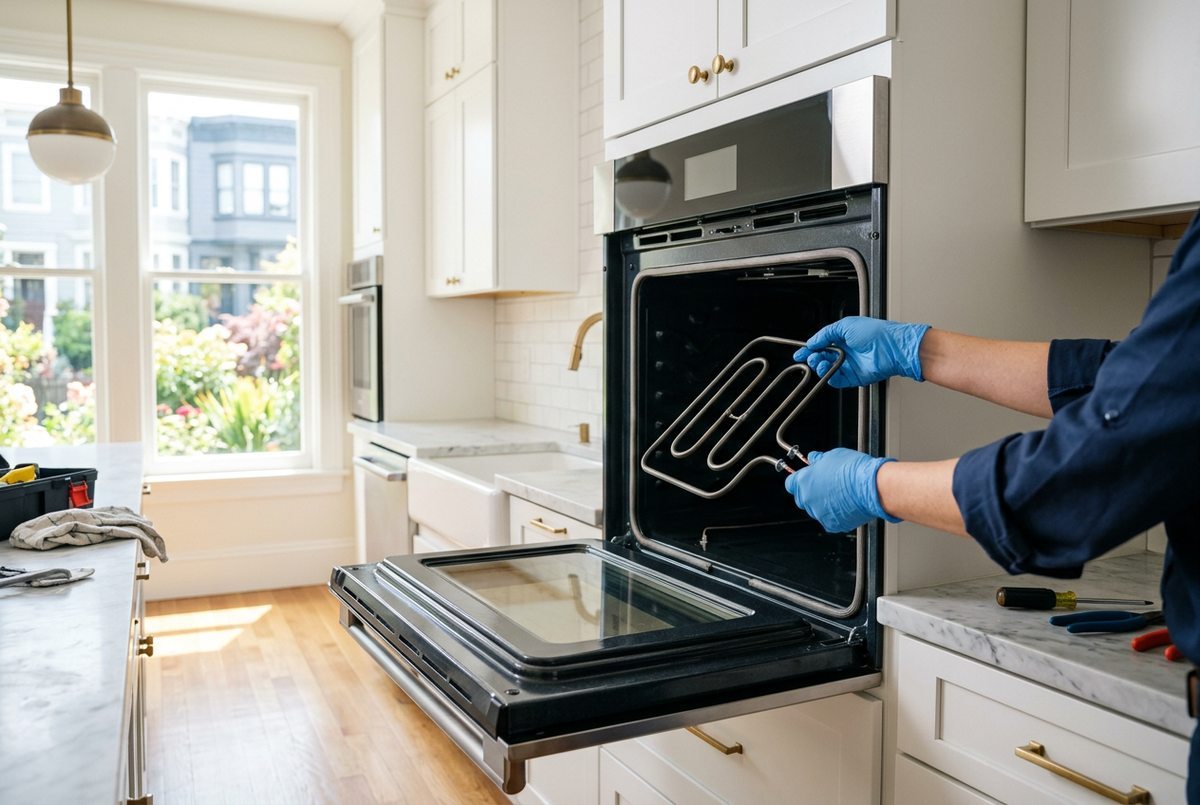
We repair gas and electric ovens across Alabama, and the fastest way to start is to describe the symptom. Cookies pale on one side. The broiler glows but the bake element stays dark, or the display flashes a code nobody in the house can read. We treat those as symptoms, not verdicts. Usual culprits are a burned-out bake or broil element, a failed igniter on gas models, a temperature sensor that has drifted, a stuck door lock, or a relay board losing its grip. A visit starts with questions, then meter readings, then a look at the parts that actually control heat. We explain what we found in plain words, and we give second opinions when another shop already guessed. Call us and tell us what the oven is doing.
Call (800) 712-6387- Real people on the phone
- 7 days a week
- Quote in writing before any work
Taking calls until 5:00 PM CT
The oven symptoms we hear most
- "It heats, but everything burns on the bottom." Sensor drift, a calibration offset, or a broil element failing and skewing where the heat goes.
- "The oven clicks and clicks and never lights." A weak gas igniter drawing too little current to open the safety valve.
- "Bake does nothing, broil works fine." An open bake element, or a bake relay on the control board that has failed.
- "Door locked itself after I ran self-clean." Door lock motor stuck, or a thermal cutout tripped by self-clean heat.
- "Display shows a code and beeps nonstop." Control board fault, a shorted sensor circuit, or a keypad losing contact.
Safe things to check first
Worth a look before you call — sometimes it saves you the visit.
- 1Confirm the oven breaker is fully on. A half-tripped double breaker can leave clock power with no heat.
- 2Make sure the panel is not sitting in delay start, timed bake, or Sabbath mode.
- 3Look through the door at the bake element for uneven glow, a visible break, or a blister.
- 4Put an oven thermometer on the middle rack and see how far actual temperature strays from the setting.
What homeowners get from an independent shop
| G Appliances MD | Big-box repair chains | Handyman listings | |
|---|---|---|---|
| Written quote before any work | ✓ | ✕ | ✕ |
| Live answer seven days a week | ✓ | ✕ | ✓ |
| Every major brand, gas or electric | ✓ | ✓ | ✕ |
| No manufacturer targets to hit | ✓ | ✕ | ✓ |
| Crews familiar with homes like yours | ✓ | ✕ | ✓ |
Homeowners on how the visit went
“Straightforward people. The written quote made the decision easy.”
Monica T.Luverne, AL“Fixed the ice maker and showed me why it jammed so I can stop it happening again.”
Ray S.Eutaw, AL“Washer walked across the floor on spin for a year. Turns out one shock absorber. Wish I had called sooner.”
Beth L.Hartford, ALOven Repair — quick answers
How do you diagnose an oven that heats unevenly?
We measure actual cavity temperature against the setting, then check sensor resistance, element condition, and the door seal. Uneven heat almost always traces to one of those four. The reading tells us which one, instead of swapping parts and hoping.
Is it worth repairing an older oven?
Often yes, if the cabinet and door are sound and parts are still available. Elements, igniters, and sensors are routine work. When a control board is needed on a worn-out appliance, we will say so and tell you replacement makes more sense.
My oven smells like gas. What should I do?
Stop using it. Shut the gas valve if you can reach it safely, open windows, and leave the home if the smell is strong. Call your gas utility first. Once they clear the home, call us to look at the appliance.
Do you work on gas and electric ovens?
Both, plus wall ovens, ranges, and double-oven units. We are an independent shop and service all major brands. Tell us the fuel type and roughly how old the unit is when you call, so we show up with likely parts.
Why did my oven fail right after self-clean?
Self-clean pushes the cavity to extreme heat, and that stress can open a thermal fuse, cook a sensor, or stick the door lock. It is one of the most common reasons a working oven dies overnight.
Can I get a second opinion on a quoted repair?
Yes, and we take those calls often. Bring us the diagnosis you were given. We run our own readings and tell you whether the findings line up, with no pressure to book the work with us.
How it works
- Step 1
Describe the symptom
Tell us what you hear, smell, or see. Is it grinding, is there a puddle on the floor, is a code blinking at you? Small details narrow the list of likely causes before we ever pull the machine away from the wall.
- Step 2
We examine the machine
A technician works a checklist: power, controls, sensors, motors, seals, drainage. We test instead of guessing. Then we walk you through the actual fault and what your repair options are.
- Step 3
You choose the treatment
Some faults are worth fixing the same day. Others mean the appliance is near the end of its life. We tell you which one you're looking at, and we finish the repair once you say go.
- A real person answers
- Open 7 days
- Written quote before work starts
Why homeowners call us
- We think like diagnosticiansSwapping parts until something works costs you time. We trace the symptom back to its cause and confirm it with a test, then repair the thing that actually failed rather than the thing that merely looked suspicious.
- Second opinions are fine by usSomeone already told you the compressor is done, or that the control board is fried? Bring us in to check. We'll run our own examination and tell you honestly whether that diagnosis holds up.
- Brand-independent serviceWe're an independent repair company, and we work on refrigerators, washers, dryers, dishwashers, ovens, ranges, and freezers from all major brands. No brand steers our recommendation toward replacement over repair.
- Straight talk on repair or replaceNot every appliance deserves a rescue. If the numbers and the condition point toward a new unit, we say so. What you get is facts about your machine, not pressure to book work.
- All major brands, gas & electricEvery major appliance brand, gas and electric, handled by an independent shop.
- Straight answersWhen a repair doesn't make sense, we tell you, sometimes before we even roll a truck.
Oven Repair
Small faults become big ones on a schedule of their own
Describe the symptoms and we'll book the visit — takes about a minute.
- A real person answers
- Open 7 days
- Written quotes
- All major brands
- Gas & electric
Rather not call? Get a free quote →